

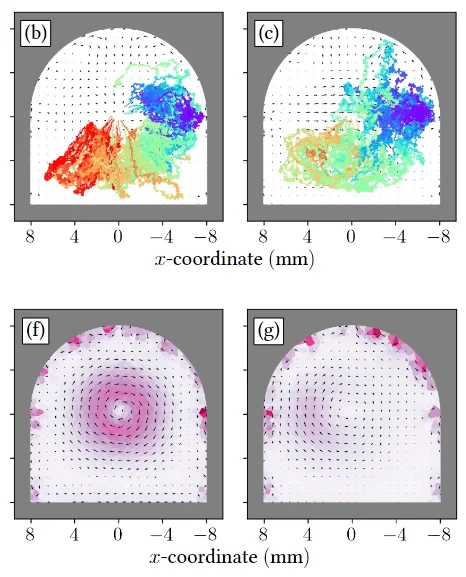
Performing quantum experiments with molecules requires cooling them down in the first place. Cryogenic buffer-gas beam sources have become an essential tool for producing cold molecular beams. Numerical studies of buffer-gas cooling have so far remained limited due to the challenges posed by the large parameter ranges needed to describe both the dense buffer gas and the dilute seed molecules. In this article, we investigate hydrodynamic effects, including vortex formation in a dome-shaped cell, and assess whether these can be exploited to enhance the performance of molecular cooling and extraction. We combine steady-state slip-flow simulations for helium buffer gas and employ a direct-simulation Monte Carlo diffusion routine to track particle trajectories.
See more details on NJP: https://iopscience.iop.org/article/10.1088/1367-2630/ae1ce6